
Transparency advocates prepare for legislative session
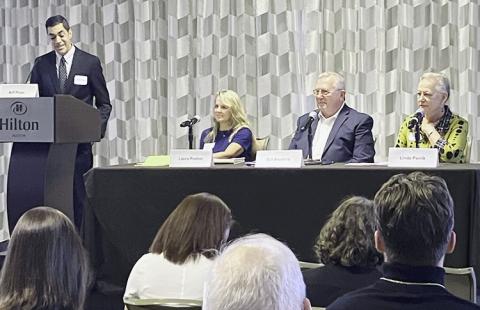
Arif Panju, (far left) managing attorney (Texas) Institute for Justice, and a member of the executive committee for the Freedom of Information Foundation board of directors, moderated a panel session on priorities for the 2025 Legislative session during the recent FOI annual state conference. Panelists were (seated, from left) First Amendment attorney Laura Prather, a partner at Haynes and Boone, LLC; First Amendment attorney Bill Aleshire; and Linda Pavlik, award-winning former investigative reporter representing the Texas League of Women Voters.
Government transparency advocates are celebrating a key victory in the never-ending government transparency battle while gearing up to fight again to strengthen the Texas Public Information Act in the 2025 legislative session.
In a session during the Freedom of Information Foundation of Texas annual conference, First Amendment Attorney Laura Prather noted an important success in the last session: the closure of the “dead suspect loophole.” Before the 2023 reform legislation, the loophole gave police discretion to withhold information about people who die in custody and therefore did not go through the court system.
“It took four sessions to accomplish that,” Prather said.
She reminded the audience of testimony from Robert and Kathy Dyer, parents of Graham Dyer, who died in 2013 while in police custody in Mesquite. She also recalled the testimony of parents of children killed in the Uvalde school shooting in 2022 when the shooter was killed. Information and records were withheld in these cases by authorities using the dead suspects loophole.
The Dyers’ dedication and testimony in four legislative sessions shows the importance of being resilient, Prather said.
“It is that resilience everyone needs to demonstrate this session as we bring forward a number of measures that we have been fighting for over and over,” she said.
Prather, a partner at Haynes and Boone, LLP, was joined on the panel by Linda Pavlik of the League of Women Voters and First Amendment Attorney Bill Aleshire, a former Travis County Judge who started his career as a legislative staff member in the Texas Legislature in the 1970s. He was administrative assistant to the House sponsor of the Texas Open Records Act, now known as the Texas Public Information Act. The panelists are members of the Sunshine Coalition, a group of 18 organizations recognizing the need to strengthen state transparency laws.
In the 2025 session, transparency advocates will once again lobby for the release of dates of birth when submitting a TPIA records request and for measures to make the information request process more user-friendly and enforceable.
Access to dates of birth in some public records, such as criminal justice documents, promotes accuracy in news reporting, especially when common names are involved. DOBs also help ensure that background check companies and other businesses are obtaining accurate information when searching criminal justice records.
Dates of birth in applications by candidates for public office help the public vet candidates and better understand who is on the ballot. Pavlik related recent instances when League of Women members working on their annual voters’ guide were denied contact information for candidates in some city elections.
“It doesn’t make sense,” she said.
Pavlik also recalled that one city secretary said campaign contribution reports would no longer be available, citing the personal information available in the reports.
Another returning issue is the computer format of government records that actually are released. “If you have a document in a certain format, you should release it in that format,” Prather said.
She noted that spreadsheets are the most usable format for certain data, but instead of producing requested documents in the spreadsheet form in which they are kept, many governmental entities convert the documents to PDF images. That makes it difficult to search and sort information.
The Texas Attorney General’s Office has said information should be provided in the format requested if it’s available in that form. The Sunshine Coalition is backing efforts to codify that guidance into law.
The panelists also cited issues with getting entities to respond to TPIA requests at all. Governmental entities often delay releasing public information or even ignore requests completely, knowing requestors may be unable or unwilling to incur the legal expenses to win a court order to enforce the TPIA. A common stalling tactic used by government officials is waiting until a deadline is on the doorstep before requesting an attorney general’s opinion on whether routine information is public.
Prather said the attorney general’s office “is overloaded with requests” on information access questions that could easily be resolved by communication. She suggested that a new “respond, meet and confer” requirement could help keep many requests from being sent to the AG in the first place. If both parties talk about what records the requester is seeking, most issues could be resolved, Prather said. She proposed a mediation system, perhaps utilizing State Office of Administration judges.
In addition, recent appellate court decisions have made it extremely difficult for requesters to recover attorney’s fees under the TPIA. Precedent allows governmental entities to hand over documents at the last minute — even after months of litigation — and avoid paying any attorney fees encumbered by the requestor. Once a record is turned over, Prather explained, the issue becomes moot and the case is closed before the issue of awarding fees can be considered.
In 2017, an attorney fees bill with provisions similar to those in the federal FOI law passed the Texas legislature, only to be vetoed by Gov. Greg Abbott. Another way to address the issue could be through declaratory judgment, which would give an option for awarding fees.
Other user-friendly proposals include legislation requiring that a public information hotline be administered by the Attorney General’s office so citizens can ask questions about open records issues and perhaps receive assistance in filing a request. Prather said there was an AG open records hotline in the past, but apparently it no longer operates.
Prather also called for more education for elected officials and their attorneys, noting instances when city attorneys gave incorrect information to city councils because they weren’t familiar with specific aspects of the law.
The regular biennial session of the 89th Texas Legislature will convene on Jan. 14 and adjourn 140 days later, on June 2.
- Log in to post comments